Too Sweet to be True: The Dangers of Artificial Sweeteners
Too Sweet to be True: The Dangers of Artificial Sweeteners
Chaemin Kim
Thomas Jefferson High School for Science and Technology
This article placed 1st in the 2025 Teknos Fall Writing Contest.
Picture this: You walk into a grocery store, pick up a sweet treat, and scan through its list of ingredients. You may notice unusual ingredients used in place of sucrose—the chemical name for table sugar—but more often than not, they pass unquestioned and end up in your shopping cart anyway. The truth is, today’s sugar culture is changing. What mainstream companies, such as Coca-Cola and PepsiCo, once relied on for sweeteners—cane sugar and high-fructose corn syrup—are now being replaced by erythritol, aspartame, stevia, and sucralose. These sweeteners contain little to no calories and are promoted as healthier alternatives to sugar. However, reality may not be as sweet as it seems.
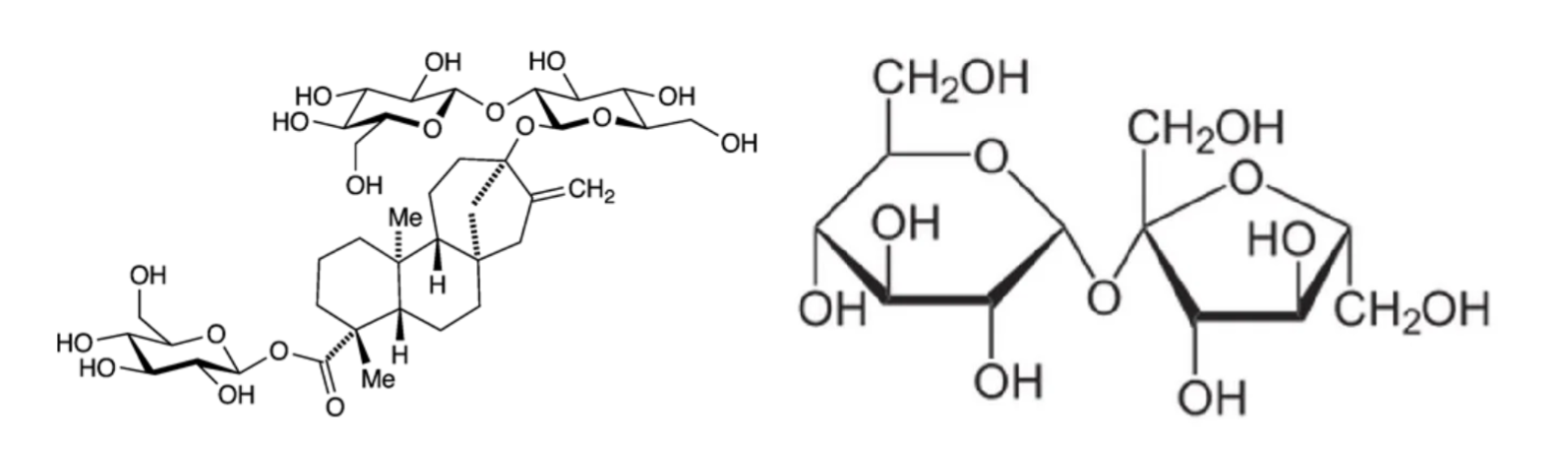
Figure 1. Chemical structure of steviol glycoside (left), the main ingredient of stevia, and sucralose (right), also called table sugar [16, 17]
Artificial sweeteners mimic sugar’s molecular structure—a carbohydrate made of carbon, hydrogen, and oxygen atoms—which interacts with taste receptors T1R2 and T1R3 on the tongue. The receptors produce a protein called TAS1R2/3 that is converted to a signal the brain interprets as a sugary taste [1, 9]. Many artificial sweeteners are 200 to 700 times sweeter than regular table sugar in terms of relative sweetness, making them a cost-efficient ingredient for manufacturers [10]. Another benefit is their low calories; stevia, for example, boasts its zero-calorie status. All of these benefits make artificial sweeteners more popular than sugar for companies that promote wellness and weight loss.
One of the most commonly used artificial sweeteners is erythritol, a sugar alcohol that is 70% as sweet as table sugar while containing only 6% of its calories [2, 6]. Erythritol became popular because it does not cause blood sugar spikes, as the human body lacks the enzymes needed to break down its compounds into glucose. Companies like Alani Nu, an energy drink brand, and Halo Top, a diet ice cream brand, use erythritol to make their products calorie free. However, erythritol is linked to numerous health issues, including an increased risk of cardiovascular diseases—such as coronary artery disease, peripheral artery disease, and heart failure—after long-term consumption [11, 13].
When erythritol is consumed, it is quickly absorbed into the small intestine and enters the bloodstream. Its structure remains mostly unaltered. In a study by the American Heart Association in 2024, erythritol was given to experimental groups of people with no preexisting cardiovascular or kidney conditions. The study revealed that the consumption of erythritol enhanced stimulus-dependent release of serotonin, a dense granule marker, and CXCL4, an alpha granule marker. Both dense and alpha granules are stored in platelets and promote clotting, inflammation, and platelet recruitment, accelerating the chances for thrombosis, which is the formation of blood clots in veins and arteries. Therefore, a higher level of serotonin and CXCL4 in blood result in higher platelet activity and faster thrombosis formation as a result [14].
Aspartame is another widely used, controversial artificial sweetener found in Diet Coke, Diet Pepsi, Extra chewing gum, cornflakes, and other sugar free desserts. Recently, aspartame drew attention after the World Health Organization (WHO)’s International Agency for Research on Cancer (IARC) declared it possibly carcinogenic to humans, moving the sweetener up to IARC Group 2B. Though some dismissed the concern as exaggerated, evidence suggests that aspartame’s biological and chemical effects may cause certain types of cancer.
A study published in the Food and Chemical Toxicology journal in 2021 found that aspartame increases cancer stem cell populations and aggressiveness by affecting the c-Myc oncogene and OCT3/4 transcription factors in cell DNA [4, 3]. Usually, c-Myc regulates cell growth, proliferation, and metabolism in cells, while the transcription factors OCT3 and OCT4 maintain stem cell regeneration and regulate gene expression. Although aspartame did not affect tumorigenicity, the tendency to produce tumors, it did support the self-renewal of cancer cells through OCT3/4 and c-Myc factors in pancreatic cancer cells grown in the lab [8].
The problems of artificial sweeteners extend beyond the heart and cancer cell growth. A 2024 NIH study revealed that long-term exposure to sucralose, a zero-calorie sugar, induces neuroinflammation and ferroptosis, an iron-dependent form of cell death [7]. Microglia are cells that maintain immunity and defense mechanisms in the brain, and HMC3 cells are an experimental model of them. Deaths and proliferation inhibition of HMC3 cells were frequent at concentrated or long-term exposures to sucralose The neuroinflammation caused by sucralose in the HMC3 cells suggests that sweeteners which are advertised as healthy may impair cognitive abilities.
A separate study published in Neurology in September 2025 showed that six low and no calorie artificial sweeteners—aspartame, erythritol, saccharin, acesulfame-K, sorbitol, and xylitol—can accelerate cognitive decline, especially in memory and verbal skills [5, 12]. Among 12,772 participants studied over 8 years, those under 60 years old who consumed the most artificial sweeteners displayed a cognitive decline 62% faster than those who had the lowest intake, equivalent to 1.6 years of brain aging. Researchers suspected that artificial sweeteners may influence the brain through mechanisms of neuroinflammation like sucralose did in the previous study.
Behind the healthy, low-calorie claims of artificial sweeteners, science tells a contrasting story of cardiovascular diseases, cancer, and cognitive decline. Despite this, many artificial sweeteners are generally recognized as safe by the FDA. More research has yet to be done on the exact mechanisms of how these compounds interact with specific biological processes in the body. Understanding how far the dangers of artificial sweeteners can go is crucial for addressing their safety. For now, it is best to avoid artificial sweeteners—they are too sweet to be truly healthy.
References
[1] Belloir, C., Brulé, M., Tornier, L., Neiers, F., & Briand, L. (2021). Biophysical and functional characterization of the human TAS1R2 sweet taste receptor overexpressed in a HEK293S inducible cell line. Scientific Reports, 11(1). https://doi.org/10.1038/s41598-021-01731-3
[2] Cleveland Clinic. (2025, January 8). What’s Erythritol? And Is It Bad for You? https://health.clevelandclinic.org/erythritol
[3] Dusek, J., Carazo, A., Trejtnar, F., Hyrsova, L., Holas, O., Smutny, T., Micuda, S., & Pavek, P. (2017). Steviol, an aglycone of steviol glycoside sweeteners, interacts with the pregnane X (PXR) and aryl hydrocarbon (AHR) receptors in detoxification regulation. Food and Chemical Toxicology, 109, 130–142. https://doi.org/10.1016/j.fct.2017.09.007
[4] Gezginci-Oktayoglu, S., Ercin, M., Sancar, S., Celik, E., Koyuturk, M., & Bolkent, S. (2021). Aspartame induces cancer stem cell enrichment through p21, NICD and GLI1 in human PANC-1 pancreas adenocarcinoma cells. Food and Chemical Toxicology, 153, 112264. https://doi.org/10.1016/j.fct.2021.112264
[5] Gonçalves, N. G., Martinez-Steele, E., Lotufo, P. A., Bensenor, I., Goulart, A. C., Barreto, S. M., Giatti, L., de Faria, C. P., Molina, M. del C. B., Caramelli, P., Marchioni, D. M., & Suemoto, C. K. (2025). Association Between Consumption of Low- and No-Calorie Artificial Sweeteners and Cognitive Decline. Neurology, 105(7). https://doi.org/10.1212/wnl.0000000000214023
[6] Gunnars, K. (2018, April 23). Erythritol — Healthy Sweetener or a Big, Fat Lie? Healthline. https://www.healthline.com/nutrition/erythritol
[7] Hacioglu, C. (2024). Long‐term exposure of sucralose induces neuroinflammation and ferroptosis in human microglia cells via SIRT1/NLRP3/IL‐1β/GPx4 signaling pathways. Food Science & Nutrition, 12(11), 9094–9107. https://doi.org/10.1002/fsn3.4488
[8] Han, S., Yang, J., Park, J. E., & Kim, J. H. (2024). Artificial Sweeteners and Pancreatic Cancer: Is Aspartame a Culprit or a Coincidence? Pakistan Journal of Medical Sciences, 40(4). https://doi.org/10.12669/pjms.40.4.8490
[9] Howard Hughes Medical Institute. (2025, May 7). Scientists unveil the structure of the receptor responsible for how we taste sweetness. https://www.hhmi.org/news/scientists-unveil-structure-receptor-responsible-how-we-taste-sweetness
[10] Johns Hopkins Medicine. (n.d.). Facts about Sugar and Sugar Substitutes. Johns Hopkins Medicine. https://www.hopkinsmedicine.org/health/wellness-and-prevention/facts-about-sugar-and-sugar-substitutes
[11] Myers, C. (2024, August 14). A New Study Links a Popular Artificial Sweetener with Higher Blood Clot Risk—Here’s What to Know (J. Ball, Ed.). EatingWell. https://www.eatingwell.com/new-study-links-erythritol-with-higher-blood-clot-risk-8695390
[12] Rizzo, N. (2025, September 3). 7 Artificial Sweeteners Linked to Cognitive Decline in New Study. TODAY.com; TODAY. https://www.today.com/health/diet-fitness/artificial-sweeteners-cognitive-decline-study-rcna228871
[13] Sun, T., Yang, J., Lei, F., Huang, X., Liu, W., Zhang, X., Lin, L., Sun, L., Xie, X., Zhang, X.-J., Cai, J., She, Z.-G., Xu, C., & Li, H. (2024). Artificial sweeteners and risk of incident cardiovascular disease and mortality: Evidence from UK Biobank. Cardiovascular Diabetology 23, Article 233. https://doi.org/10.1186/s12933-024-02333-9
[14] Witkowski, M., Wilcox, J., Province, V., Wang, Z., Nemet, I., Tang, W. H. W., & Hazen, S. L. (2024). Ingestion of the Non-Nutritive Sweetener Erythritol, but Not Glucose, Enhances Platelet Reactivity and Thrombosis Potential in Healthy Volunteers. Arteriosclerosis Thrombosis and Vascular Biology. https://doi.org/10.1161/atvbaha.124.321019
[15] World Health Organization. (2023, July 14). Aspartame Hazard and Risk Assessment Results Released. https://www.who.int/news/item/14-07-2023-aspartame-hazard-and-risk-assessment-results-released
[16] American Chemical Society. (2018). Chemical Structure of Stevioside. American Chemical Society. https://www.acs.org/molecule-of-the-week/archive/s/stevioside.html
[17] Lajolo, F. (2020). Sucrose molecular structure. ResearchGate. https://www.researchgate.net/figure/Sucrose-molecular-structure_fig1_343529264